
The Golden Ratio in Healthcare IT Infrastructure
The golden ratio appears in architecture, music, and design because it describes something humans intuitively recognize as proportionally right. Nothing is oversized or starved. Everything pulls its weight in relation to everything else. That same principle applies to healthcare IT infrastructure, and most organizations are not hitting it.
A CIO can build a flawless zero-trust security posture, deploy a fully integrated EHR, and still leave clinical imaging running on aging on-premises hardware from 2016. The result is not a secure, modern health system. It is a system that is secure and modern in some directions and brittle in others. That asymmetry creates risk, workflow friction, and real financial exposure.
This guide is for digital health leaders thinking through how to allocate infrastructure investment with the same rigor they apply to clinical outcomes.
Why Balance Is Harder Than Modernization
Healthcare organizations have been modernizing IT for a decade. They have moved email to the cloud, deployed telehealth platforms, migrated to cloud-based EHR infrastructure, and trained staff on two-factor authentication. The investment is real and accelerating, with healthcare cloud adoption now leading all other industries in year-over-year growth.
The Problem Is Selective Adoption
Budget cycles, vendor lock-in, and departmental silos mean that modernization tends to cluster around the systems with the loudest advocates in the room. Usually, that is EHR, security, and revenue cycle.
Clinical imaging rarely has a loud advocate in the C-suite. When costs are high and the imaging department is not represented at budget negotiations, imaging infrastructure gets deferred. Again. The consequence is imbalance, and imbalance carries compounding costs over time.
The Five Pillars of Healthcare IT Infrastructure
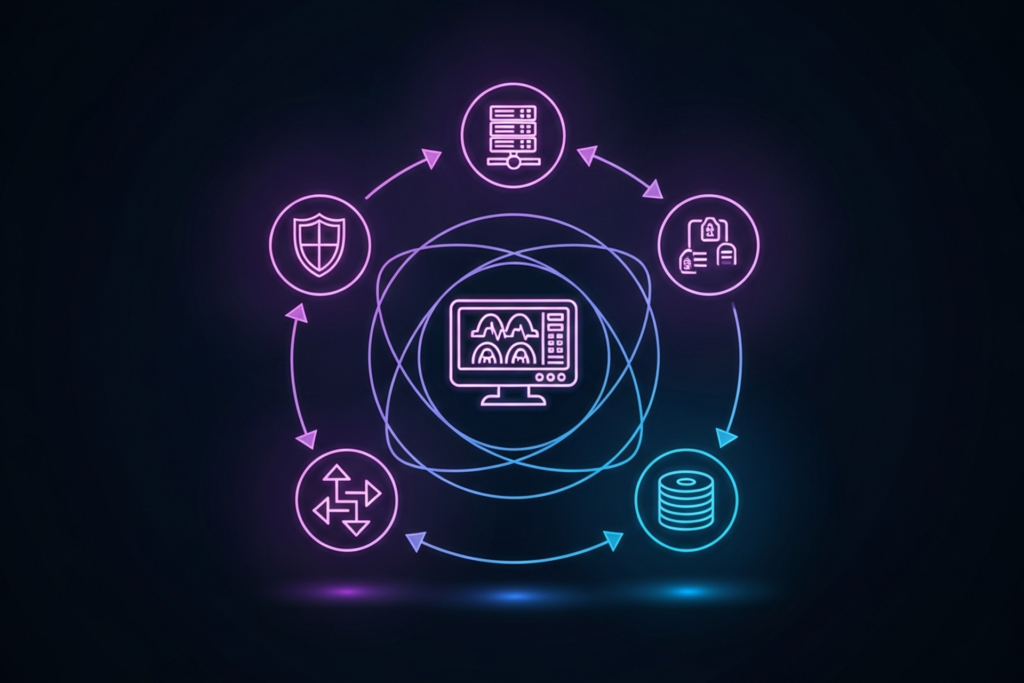
Before diagnosing the gap, it helps to map the terrain. A well-architected healthcare IT environment rests on five interdependent pillars. Weakness in any one of them degrades the others.
1. Security and Compliance
This is the pillar that gets the most funding, and for good reason. HIPAA, HITECH, and the expanded requirements emerging from the federal health IT strategy for 2024-2030 make security investment non-negotiable. Healthcare data breaches remain the most expensive of any industry, and compliance is only getting more complex.
2. Network and Compute
Bandwidth, latency, and compute capacity underpin everything from telehealth sessions to AI-assisted diagnostics. Underpowered network infrastructure is the hidden bottleneck that makes every other investment perform below expectations.
3. Storage and Data Management
Healthcare generates enormous volumes of structured and unstructured data. Imaging data alone grows at roughly 30% annually at most health systems. Storage decisions made today determine how accessible, searchable, and cost-effective that data is for the next decade.
4. Interoperability
FHIR adoption, TEFCA participation, and API-first integrations determine whether clinical data flows smoothly across care settings. A system that cannot share data reliably cannot deliver coordinated care, regardless of how sophisticated its individual components are. Medical imaging system integration is a specific area where interoperability gaps cause measurable clinical delays.
5. Clinical Workflow Systems (Including Imaging)
EHR, order management, scheduling, and clinical decision support tools live here. So does PACS. This pillar is where the actual work of care delivery happens, and it is frequently the last to receive modernization investment proportional to its importance.
A truly balanced healthcare IT infrastructure treats all five pillars as co-equal. The golden ratio breaks down when one pillar receives two or three times the investment of another.
The Imaging Gap Hiding in Your IT Strategy
Clinical imaging is one of the most data-intensive workflows in all of healthcare. A single CT scan can generate several hundred images. A busy radiology department at a regional hospital processes thousands of studies per week. The raw storage requirements are significant, but storage is only part of the picture.
On-Premises PACS as Infrastructure Anchors
On-premises PACS systems have become dead weight for many organizations: large, expensive to maintain, difficult to scale, and deeply integrated into clinical workflows in ways that make replacement feel risky. Hospitals that have not migrated to cloud-based or hybrid PACS architectures are absorbing disproportionate operational costs while falling behind on AI-readiness and multi-site access.
Nearly two-thirds of healthcare organizations are already using or planning to use cloud for image storage within the next three years. This is not a future trend. It is a present-day infrastructure decision that organizations are making right now.
OmniPACS operates directly in this space, providing cloud-based PACS that removes the hardware burden, scales with imaging volume, and connects across care settings without requiring expensive on-site infrastructure upgrades. For CIOs mapping where their infrastructure is out of balance, imaging is often the answer, and OmniPACS solutions are designed to close that gap without a full system overhaul.
What a Balanced Healthcare IT Stack Looks Like in 2026
A well-proportioned digital healthcare strategy in 2026 shares several common characteristics. It is not defined by any single vendor or platform. It is defined by intentional architectural decisions.
Hybrid Cloud by Design
Not everything belongs in the cloud, and not everything belongs on-premises. The right balance is a deliberate mix of on-premises compute and cloud services, each handling what they do best. Latency-sensitive applications and certain regulated workloads may stay local, while storage-heavy systems like PACS gain the most from cloud elasticity.
AI-Ready at the Infrastructure Level
AI tools for diagnostic support, image analysis, and operational efficiency require specific infrastructure conditions: low-latency access to imaging data, compute resources that can handle inference workloads, and data governance frameworks that meet privacy requirements. Organizations that have modernized imaging infrastructure are far better positioned to deploy and actually use AI tools.
FHIR and TEFCA Compliance Built In
Interoperability requirements are not going away. Health systems that bake FHIR-compliant APIs and TEFCA participation into their infrastructure decisions now will avoid expensive retrofits in the next budget cycle.
Imaging Integrated, Not Isolated
PACS should not sit in a corner of the IT map, connected only to radiology. A balanced architecture connects imaging data to EHR workflows, to referring provider access portals, and to population health tools. OmniPACS supports this kind of connectivity by design, with native EHR and PACS integration that eliminates the silos most health systems still contend with.
A healthcare organization that invests proportionally across all five pillars does not just run a tighter IT operation. It delivers faster diagnoses, more coordinated care, and a more resilient infrastructure.
Frequently Asked Questions
What are the five pillars of balanced healthcare IT infrastructure?
The five pillars typically include clinical systems, cybersecurity, interoperability, data analytics, and medical imaging infrastructure. Most CIOs invest heavily in the first four but underinvest in imaging, which creates a structural gap that affects diagnostic workflows and care coordination across departments.
Why is medical imaging often the weakest pillar in healthcare IT strategy?
Imaging infrastructure is frequently treated as a departmental concern rather than an enterprise priority, leaving it on aging on-premise systems while other areas modernize. This imbalance creates bottlenecks in radiology throughput, remote access, and cross-facility collaboration that directly affect patient care timelines.
How does OmniPACS help close the imaging gap in a balanced IT strategy?
OmniPACS is a cloud-native PACS that can be layered into an existing IT stack without displacing other clinical systems, making it a practical way to bring imaging infrastructure up to the same standard as the rest of the enterprise. It handles multi-site access, storage scaling, and uptime without requiring dedicated on-site IT resources.
What does “golden ratio” mean in the context of healthcare IT investment?
The golden ratio concept refers to achieving proportional investment across all five pillars so no single area becomes a bottleneck. When imaging lags behind other systems, the overall efficiency of the clinical operation suffers even if the other four pillars are well-funded and well-managed.
What This Means for Your Organization
The golden ratio is not a formula. It is a commitment to looking honestly at where investment is concentrated and where it is thin. For most healthcare organizations, the audit reveals the same thing: security is strong, EHR is modernized, and imaging is the gap.
Closing that gap does not require a full system replacement. A phased migration to cloud PACS, starting with archive storage and expanding to active workflows, lets organizations modernize imaging without disrupting radiology operations. OmniPACS has a detailed PACS migration guide for organizations planning that transition.
OmniPACS works with health systems at different stages of this journey, from initial infrastructure assessments to full cloud PACS deployments. The goal is the same regardless of where a system starts: a proportional, resilient, and clinically effective IT environment. With scalable monthly plans that match each organization’s current volume, getting started does not require a large upfront commitment.