Pain Management Imaging Technology: Why Clinics Need Integrated PACS
Pain management is one of the most imaging-dependent specialties in medicine, yet many pain clinics still treat imaging as an external dependency rather than an integrated part of their workflow. Physicians order studies through outside facilities, wait for CDs or portal links, and pull up prior comparisons only when they happen to be available. That friction compounds across every patient encounter, every procedure day, and every follow-up visit. A modern approach to pain management imaging technology closes that gap by putting the right studies in front of the right clinician at the right moment.
How Pain Management Relies on Imaging at Every Stage
Imaging in pain management is not limited to diagnosis. It is embedded in treatment delivery from the first evaluation through long-term monitoring.
Fluoroscopy-Guided Injections
Fluoroscopy is the workhorse of interventional pain. Epidural steroid injections, facet joint injections, and sacroiliac joint procedures all use real-time fluoroscopic guidance to confirm needle placement before contrast is injected. The procedural images captured during these cases need to be stored, retrievable, and available for comparison at the next visit.
CT-Guided Nerve Blocks
Celiac plexus blocks, stellate ganglion blocks, and lumbar sympathetic nerve blocks often require CT guidance when fluoroscopy does not provide sufficient soft-tissue contrast. These studies generate multi-slice DICOM datasets that must be accessible in the same imaging environment as a patient’s prior MRI or plain films.
MRI for Treatment Planning
Before a clinician recommends a specific intervention, MRI findings shape the entire decision tree. A patient presenting with low back pain may have a disc herniation, facet arthropathy, foraminal stenosis, or sacroiliitis, and the MRI tells the clinician which structure is the primary pain generator. Having that study accessible during the procedure visit directly affects clinical confidence.
Ultrasound-Guided Procedures
Ultrasound guidance has expanded the reach of pain procedures into peripheral joints, soft tissue, and peripheral nerves. Shoulder injections, carpal tunnel releases, trigger point injections, and peripheral nerve hydrodissection are now routinely performed under ultrasound. The images captured during these cases document needle position and treatment site, providing a procedural record that matters if outcomes are reassessed later.
The Workflow Problem: Fragmented Imaging Access
Many pain clinics operate in a state of chronic imaging fragmentation. A patient arrives for a follow-up injection with imaging done at a hospital three months ago. The CD is missing. The hospital portal requires a separate login, and the images do not load on the clinic workstation. The physician proceeds from memory or reschedules the injection.
Prior Study Retrieval
Retrieving prior studies from outside facilities is one of the most consistent friction points in pain management workflows. CDs degrade, portal links expire, and fax-based image release requests can take days. For a specialty where comparison imaging directly informs whether a treatment is working, these delays are not minor inconveniences.
No Comparison Tools at the Point of Care
Even when prior studies are available, many pain clinics lack a viewer capable of side-by-side comparison across modalities. A clinician who wants to compare a current MRI with a fluoroscopy series from six months ago needs a viewer that handles both, not a consumer-grade portal that only displays one file type at a time.
Documentation Gaps After Procedures
Procedural images captured during fluoroscopy or ultrasound guidance need to go somewhere permanent and retrievable. In clinics without integrated PACS, those images end up on a standalone workstation, emailed as JPEGs, or printed and scanned into an EMR. None of those methods supports long-term imaging continuity.
How Cloud PACS Solves Pain Clinic Imaging Challenges
A cloud PACS built for the realities of pain management does more than store images. It connects every imaging touchpoint across the patient’s care timeline.
Instant Access to Prior Studies
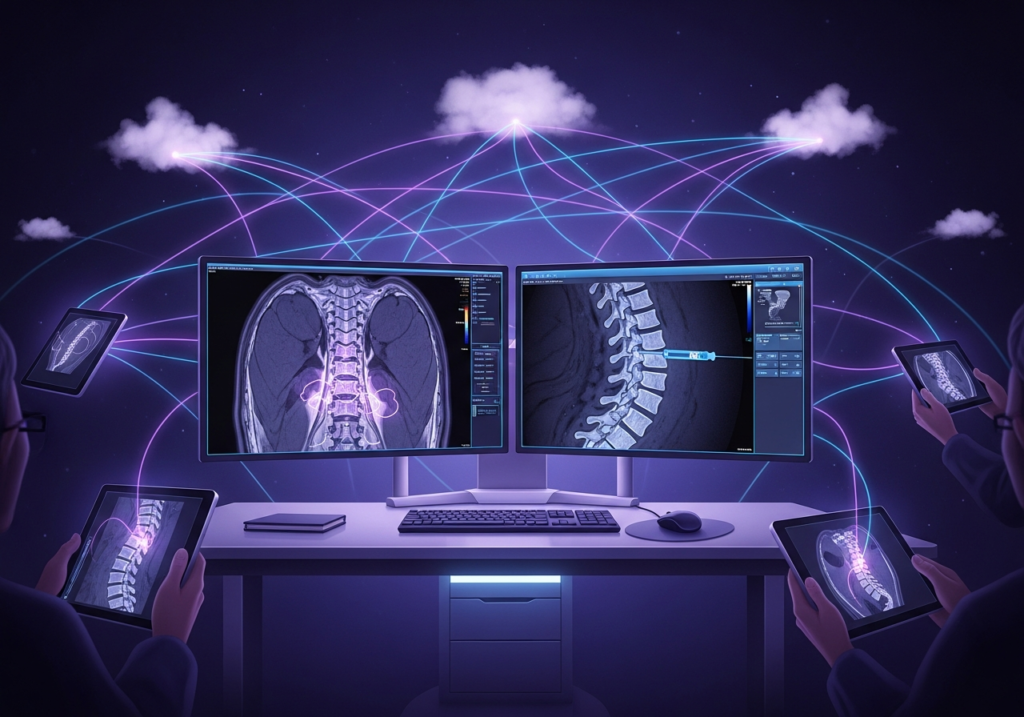
Cloud PACS gives pain clinicians access to prior studies from any facility that has shared images through the network. Rather than chasing CDs or waiting for portal access, the study is available in the same viewer used for all other imaging. A physician reviewing a patient’s chart the night before a procedure can pull the relevant imaging from any device.
For a deeper look at how PACS supports outcome-oriented workflows in this specialty, OmniPACS covers how PACS architecture supports better pain management outcomes.
Multi-Modality Viewing
Pain management generates imaging across multiple modalities: MRI, CT, fluoroscopy, and ultrasound. A cloud PACS handles all of these natively, so a clinician is never switching between viewers to see what a patient’s imaging history actually looks like. That unified view is the foundation of informed procedure planning.
Procedure Image Documentation
Fluoroscopy images and ultrasound captures from interventional procedures belong in the patient’s permanent imaging record, not on a standalone machine in a procedure suite. OmniPACS captures these images at the point of procedure and stores them alongside the patient’s full imaging history. You can see the full set of capabilities designed for this workflow on the OmniPACS services page.
Referring Physician Image Sharing
Pain clinics receive referrals from primary care physicians, orthopedic surgeons, and neurologists. A cloud PACS with secure image sharing allows the pain clinic to send procedure documentation or post-treatment imaging directly to the referring provider, without burning a CD or navigating a separate file transfer service. For clinics evaluating how remote access fits into their workflow, OmniPACS explains how cloud PACS enables faster remote imaging access.
Tracking Treatment Response Over Time
One of the most underutilized capabilities in pain management is systematic imaging comparison for monitoring how a patient responds to intervention.
Serial Comparison for Intervention Outcomes
OmniPACS makes serial imaging comparison practical at the point of care. A clinician can bring up the MRI from the initial workup alongside imaging from a follow-up visit and compare findings in the same viewer, during the same appointment. That comparison informs whether an intervention produced structural changes, whether symptoms align with imaging findings, and whether the treatment plan needs to change.
Supporting Multi-Provider Care Teams
Pain management patients are often managed across multiple providers: the interventional pain physician, a physical therapist, a psychologist, and a prescribing internist. Shared imaging access across that care team means every member is working from the same clinical picture.
Research has established that interventional radiologists optimize image-guided procedures with low-dose techniques, which makes the case for imaging infrastructure that keeps pace with procedure volume and complexity. Educational resources covering key trends shaping radiation dose management in interventional imaging reinforce that procedural imaging is not incidental documentation but a clinical record with long-term relevance.
Frequently Asked Questions
Why is procedure documentation imaging so important in pain management practices?
Fluoroscopy-guided injections and CT nerve blocks generate imaging that serves as both a clinical record and a billing and compliance document, confirming that the procedure was performed correctly and at the right anatomical target. Without a reliable PACS to store and retrieve this documentation, practices face gaps in records that can create liability exposure during audits or in the event of a complication.
What makes pain management imaging different from general radiology workflows?
Pain management practices generate high volumes of short fluoroscopy sequences and spot images rather than full diagnostic studies, which requires a PACS that handles these file types efficiently and makes them easy to associate with a specific procedure encounter. The workflow is procedural rather than diagnostic, so speed of image capture, annotation, and storage matters more than advanced reading tools.
How does a modern PACS support multi-provider pain management groups?
In a group with multiple physicians and locations, each provider needs to access procedure documentation from any site, whether for follow-up visits, peer review, or legal purposes. A cloud PACS with role-based access and a centralized archive eliminates the problem of procedure images being stranded on a local workstation or site-specific server.
How does OmniPACS fit the specific needs of a pain management practice?
OmniPACS handles multi-modality procedure imaging including fluoroscopy and CT, and its cloud architecture means that documentation from every injection suite or procedure room across a group is centralized and accessible from any device. This makes it practical for practices that perform high procedure volumes and need reliable, searchable documentation without managing on-site hardware.
Building the Right Infrastructure for Pain Management
Pain management is a high-imaging specialty that deserves imaging infrastructure built for its specific demands. Fragmented access to prior studies, limited comparison tools, and inadequate procedural documentation are not inevitable features of running a pain clinic. They are workflow problems with a direct solution in cloud PACS.
OmniPACS is built to support exactly the kind of multi-modality, multi-provider, procedure-heavy environment that defines modern pain management. From instant prior study retrieval to secure image sharing with referring physicians, OmniPACS gives pain clinics the imaging infrastructure their patient population requires. With scalable monthly plans designed for procedure-heavy practices, getting started does not require a large capital investment.