
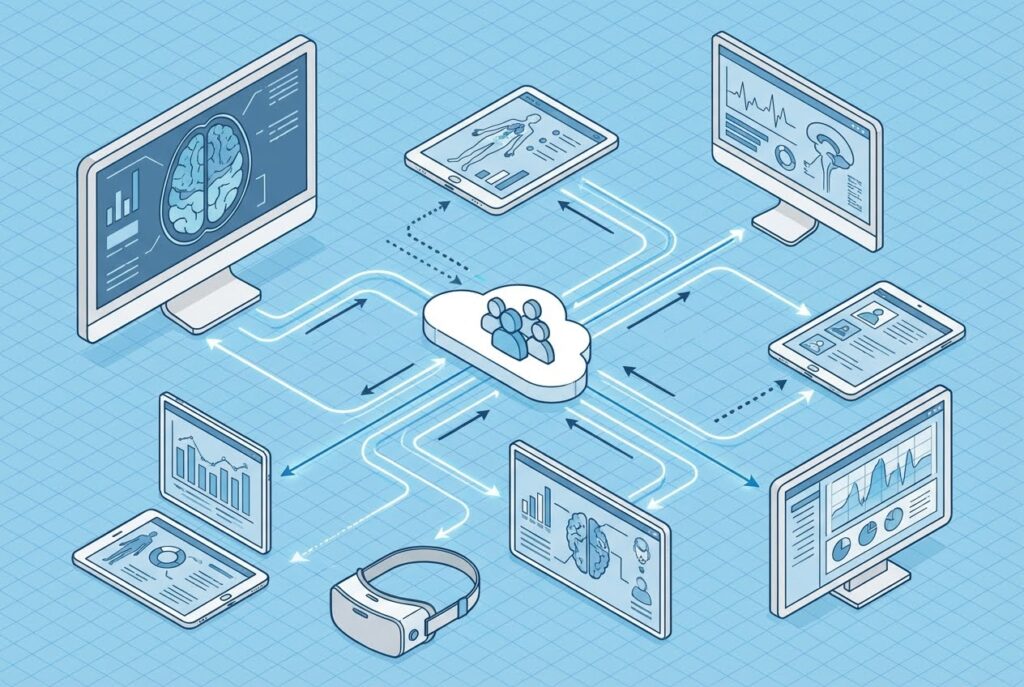
A radiologist in Boston identifies a suspicious mass on a CT scan. Within seconds, an orthopedic surgeon in Chicago views the same image, adds annotations, and a specialist in rural Montana weighs in with a differential diagnosis. This scenario, once impossible, now happens thousands of times daily. Real-time medical image collaboration has fundamentally changed how care teams operate, eliminating the delays that once cost precious hours in critical situations. The shift from isolated viewing to synchronized, multi-site access represents one of healthcare’s most significant workflow transformations in decades. For practices still relying on fragmented systems, the gap between their capabilities and modern standards grows wider each month.
The Evolution of Medical Imaging in Collaborative Care
From Static Physical Films to Cloud-Based Digital Access
Physical film archives once dominated radiology departments, requiring dedicated storage rooms and manual retrieval systems. A referring physician requesting images might wait days for films to arrive by courier. Digital imaging changed the storage problem but created new silos: PACS installations locked images within facility walls, accessible only to those with direct network connections.
Cloud-based platforms dissolved these barriers entirely. Studies now upload automatically to secure servers accessible from any authenticated device. OmniPACS exemplifies this approach, offering web-accessible viewing that eliminates dependence on local servers while maintaining diagnostic-quality rendering across devices.
The Critical Need for Speed in Acute Clinical Decisions
During an ischemic stroke, research estimates that approximately 1.9 million neurons are lost each minute without reperfusion treatment. Trauma cases require immediate cross-specialty coordination. These realities make traditional image-sharing workflows dangerous. When a neurosurgeon must physically travel to view imaging or when studies require CD burning and transport, patients suffer preventable harm.
Modern collaboration tools compress these timelines from hours to seconds, enabling simultaneous viewing and real-time discussion that matches the urgency of clinical situations.
Core Technologies Powering Real-Time Image Sharing
Zero-Footprint Viewers and Web-Based DICOM Standards
Zero-footprint viewers operate entirely within web browsers, requiring no software installation or local processing power. This architecture means any device with internet access becomes a diagnostic workstation. Modern HTML5 and WebGL rendering engines now handle complex 3D reconstructions that previously required dedicated workstations.
DICOM standards ensure universal compatibility across imaging equipment manufacturers. When combined with cloud infrastructure, these standards enable a study acquired on a GE scanner to display identically on a viewer accessing it from a tablet halfway around the world.
Interoperability Between PACS and EHR Systems
Isolated systems create dangerous information gaps. A patient’s imaging history must connect to their clinical record, lab results, and treatment plans. Modern interoperability frameworks, including HL7 FHIR protocols, enable bidirectional data flow between imaging archives and electronic health records.
This integration means clinicians see the complete picture: viewing a knee MRI while simultaneously accessing the patient’s surgical history, medication list, and prior imaging comparisons without switching applications.
Secure Synchronous Annotation and Live Consultation Tools
Static image sharing lacks context. Synchronous annotation tools allow multiple viewers to mark findings simultaneously, with each participant’s cursor visible to others. Voice integration enables natural discussion while pointing to specific anatomical structures.
These consultation features transform remote viewing from passive observation into active collaboration, replicating the experience of standing together at a lightbox while adding measurement tools and comparison capabilities impossible with physical film.
Quantifying the Impact on Patient Outcomes
Reducing Diagnostic Turnaround Times in Trauma and Stroke
Peer-reviewed studies report 30–50% reductions in door-to-treatment times when real-time collaboration tools replace traditional workflows. One multi-site trauma network reported average time savings of 47 minutes for cases requiring specialist consultation.
For stroke patients, these minutes translate directly to preserved brain tissue and improved functional outcomes. The phrase “time is brain” has never been more actionable.
Minimizing Redundant Procedures and Radiation Exposure
When images remain trapped in facility silos, patients often undergo repeat studies at new providers. This redundancy wastes resources and exposes patients to unnecessary radiation. Cloud-based image sharing with proper access controls makes prior studies immediately available, reducing duplicate imaging by an estimated 15–25% across participating networks.
Bridging Geography with Telemedicine and Remote Expertise
Empowering Rural Facilities via Virtual Specialist Consults
Rural hospitals face chronic specialist shortages. A community hospital may have excellent emergency physicians but no on-site radiologist after hours, no neurologist, and no pediatric subspecialists. Real-time image collaboration connects these facilities to urban academic centers, bringing subspecialty expertise to patients who cannot travel.
OmniPACS supports these workflows through an anywhere-access architecture designed specifically for multi-location practices and facilities needing to connect distributed care teams without complex IT infrastructure.
Global Collaboration in Rare Disease Case Management
Rare diseases often require expertise concentrated in a handful of global centers. A child in South America with an unusual bone tumor benefits when their imaging reaches specialists in Boston, Tokyo, and London simultaneously. International tumor boards now convene virtually, reviewing cases that would have remained undiagnosed a generation ago.
Addressing Security and Compliance in Shared Environments
HIPAA and GDPR Compliance for Cloud Image Storage
Cloud storage raises legitimate security questions. Reputable platforms address these through encryption at rest and in transit, geographic data residency controls, and comprehensive audit capabilities. HIPAA compliance requires documented security protocols, business associate agreements, and breach notification procedures.
GDPR, along with emerging regulations such as the EU Data Act, adds requirements for European patient data, including data portability, the right to erasure, and transparent data-sharing practices. Modern cloud PACS solutions build these compliance frameworks into their architecture rather than treating them as afterthoughts.
Role-Based Access Controls and Audit Trails
Not every user needs access to every study. Role-based controls ensure referring physicians see only their patients’ images while radiologists access their reading worklists. Emergency override protocols allow broader access when clinically necessary while logging every access event.
Complete audit trails document who viewed what, when, and from where. These logs support both compliance requirements and quality improvement initiatives.
The Future of AI-Enhanced Collaborative Diagnostics
Artificial intelligence will amplify collaborative capabilities rather than replace human judgment. AI algorithms already flag potential findings, prioritize worklists by urgency, and automate measurements. The next generation will facilitate smarter collaboration: automatically identifying which specialist should review a case based on imaging characteristics, suggesting relevant prior studies, and highlighting discrepancies between preliminary and final interpretations.
These tools work best when integrated into collaborative workflows, presenting AI findings as one input among many rather than autonomous decisions.
Frequently Asked Questions
What equipment do I need to participate in real-time image collaboration?
Most modern platforms require only a web browser and a reliable internet connection. Zero-footprint viewers eliminate software installation requirements, though diagnostic-quality displays remain important for primary interpretation.
How do cloud-based systems handle large imaging files like CT and MRI studies?
Progressive loading displays diagnostic-quality images quickly while full-resolution data streams in the background. Intelligent caching predicts which studies users will access next, preloading them for instant availability.
Can patients access their own images through these systems?
Yes. Patient portals integrated with cloud PACS allow individuals to view and download their studies, share them with providers outside the network, and maintain personal health records.
What happens if internet connectivity fails during a critical consultation?
Enterprise platforms include offline caching for active cases and automatic reconnection protocols. The U.S. Department of Health and Human Services advises critical access facilities to maintain redundant, high-availability internet connections and formal downtime contingency plans.
Making Collaboration the Standard
The transition to real-time medical image collaboration represents more than a technological upgrade: it reflects a fundamental shift toward team-based care that matches modern clinical complexity. Practices still operating with fragmented systems face growing competitive disadvantages and, more importantly, deliver suboptimal patient experiences. For organizations ready to modernize their imaging workflows, OmniPACS offers cloud-based solutions designed for fast setup and scalable growth. Their platform addresses the core challenges discussed here: anywhere access, secure sharing, and reliable DICOM routing without heavy IT overhead. Explore how streamlined imaging can transform your practice’s collaborative capabilities.